
By Paul Gerke
Things are about to get a little saltier in Wisconsin, and this time, it has nothing to do with the Green Bay Packers.
Denver, Colorado-based Peak Energy has reached a deal with massive developer RWE Americas to deploy its proprietary passively cooled sodium-ion grid storage battery technology at the RWE Lab near Milwaukee, Wisconsin.
Initially announced as a cooler-sounding pilot project in Eastern Wisconsin that would’ve marked the first deployment of such batteries on the Midcontinent Interconnected System Operator (MISO) network, the milestone is still a big one for Peak, even if that horse has to go back into the barn for now.
“Energy storage is central to providing dispatchable, reliable energy on demand,” stated Landon Mossburg, chief executive officer of Peak Energy. “Delivering the lowest cost electron is Peak Energy’s north star, and we’re proud to work with RWE Americas to deploy our cost-optimized batteries on the grid.”
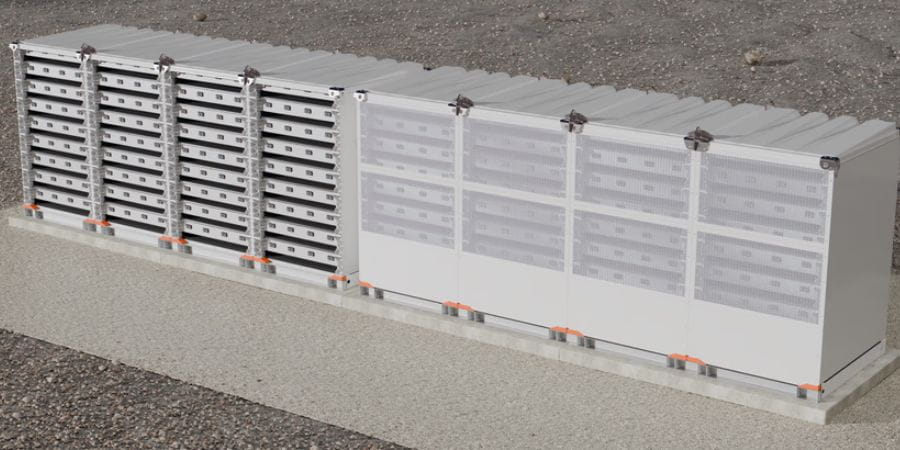
Peak Energy says its system dramatically reduces energy storage costs and eases the need for new generation, which would be a boon for ratepayers irritated by rising bills. Relying on highly stable sodium-ion (NFPP) battery cells, Peak Energy’s offering eliminates costly routine maintenance, removes cooling systems that use energy, and reduces “overbuild,” or the amount of excess storage required to account for capacity degradation over time. Its configuration enables safe operation over a wide temperature range without performance degradation, altering the economics of traditional energy storage.
By removing active cooling, fans, pumps, and other moving parts, Peak Energy says its 3.5 MWh battery energy storage system (BESS) eliminates more than 85% of the root causes behind historical BESS failures. Performance testing by Peak indicated it could reduce auxiliary power use by up to 90%, saving approximately $1 million annually per gigawatt-hour installed compared to lithium iron phosphate (LFP) systems. Peak calculates a reduction in the lifetime cost of stored energy by an average of $70/kWh, which is approximately half the current total price of a battery system.
Peak shipped its first system last summer for use in a shared pilot by nine utilities and independent power producers (IPPs), hailing it as the first-ever fully passive megawatt-hour (MWh) scale battery storage system, the largest sodium-ion phosphate pyrophosphate (NFPP) battery system in the world, and the first grid-scale sodium-ion storage solution deployed to the U.S. grid. In November, the company signed a multi-year phased agreement with Jupiter Power to supply up to 4.75 GWh of sodium-ion BESS for deployment between 2027 and 2030.
Sodium-ion battery competitor Natron Energy previously announced plans to invest $1.4 billion to establish a sodium-ion battery giga-factory in Edgecombe County, North Carolina, but the company ceased operations last year.
Last year, a report from Aurora Energy Research concluded that installing 10 gigawatt-hours (GWh) of battery storage capacity over the next decade could reduce total MISO system costs by up to $27 billion compared to a baseline scenario. If that capacity were deployed using Peak’s GS1.1 systems, the startup believes MISO could reduce total storage system costs by more than 25% compared with conventional lithium-ion solutions.
The U.S. energy storage industry installed a record-breaking 57.6 GWh of new capacity in 2025, the largest single-year increase in battery capacity on record, per the Solar Energy Industries Association (SEIA). Despite federal legislation targeting clean energy, storage installations climbed 30% from the previous record set in 2024, and are four times what the industry installed just three years ago. Over 600 GWh of energy storage is expected to be installed by 2030.
RWE Americas believes the piloting of Peak’s technology positions it as a first mover in bringing next-generation, capital-efficient energy storage to the grid.
The global developer added an additional 2 gigawatts (GW) of operating capacity in the United States in 2025, increasing its total to nearly 13 GW (12.7+) across the country. 15 recently completed projects, spanning seven states, have created thousands of American jobs and are injecting more than half a billion dollars into local communities. In 2025 alone, RWE created more than 3,500 construction jobs and committed more than $500 million toward local tax revenue and community benefits, supporting emergency services, infrastructure, and schools.
In 2025, RWE launched projects in Kentucky, Arizona, Illinois, New York, Texas, California, and Louisiana: six solar sites, four BESS, and five wind projects.
Read the full story here.
Sign up for the CREATE Newsletter and stay updated on the latest information in Renewable Energy Education.